
What changes the range
How much is being rescreened, what mesh you want, and whether the old hardware is staying.
That is usually the difference between a simple refresh and a larger rescreening scope.
For a Jacksonville pool cage, start with what needs new screen: whole walls, the roof with those walls, or just the roof. The rough-range tool prices screened wall work and can include the roof. If only the roof screen needs work, request an on-site quote so we can check what can stay.
That is usually the difference between a simple refresh and a larger rescreening scope.
Rescreening is often a good fit for an online rough range because the choices that matter are usually clear: which sections are being redone, which mesh you want, and whether the old hardware is being replaced at the same time.
For a concrete starting point, see our 20-by-30-foot Jacksonville cost example comparing 18/14 and 20/20 mesh. Then use your own measurements for a rough range.
Some enclosures need wall screen only. Others need the roof done too. That difference matters more than a rough square-foot guess.
Standard 18/14 and 20/20 no-see-um do not feel the same and they do not price the same either.
If the old fasteners and tapcons are being replaced along with the screen, it is better to include that in the number up front.
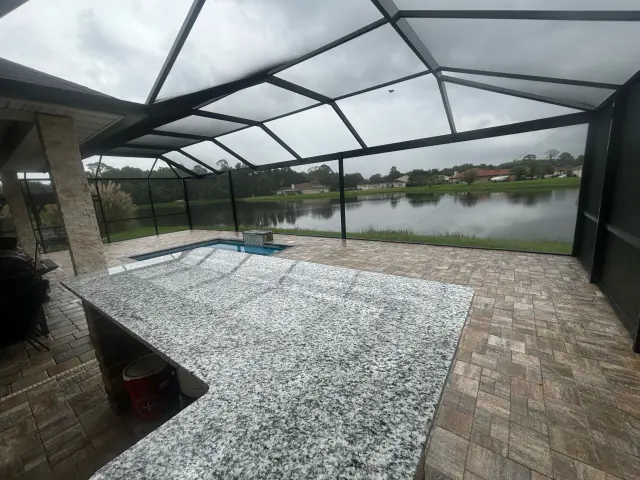
These are real North Florida enclosure photos. Their locations and rescreening histories are not identified.
For a pool cage this size, ask whether the roof and walls both need new screen before comparing quotes.
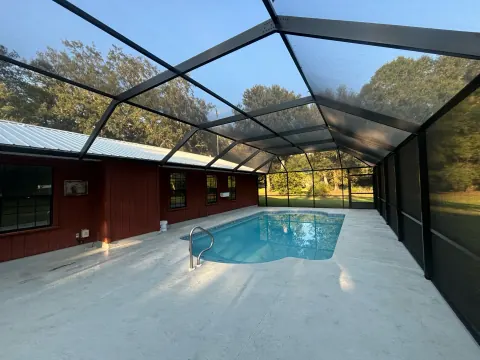
If an enclosure like this still has a sound frame, the quote can focus on the worn screen and any hardware that needs attention.
Use it when a whole side or more needs new screen. For only a few torn panels, request a repair quote instead of measuring whole sides.
Yes, for one or more whole screened sides. The tool's screen-roof choice also includes wall screen. If the roof alone needs new mesh, request a roof-only quote; we will check the surrounding screen, frame and hardware before setting the scope.
Then a simple rescreen may not be the right fix. If the structure is failing too, it makes more sense to look at rebuilds before you spend money the wrong way.
For whole-side screen work, start with the rough range. For only a few torn panels, request a repair quote. If the frame may need work, ask for an on-site review.